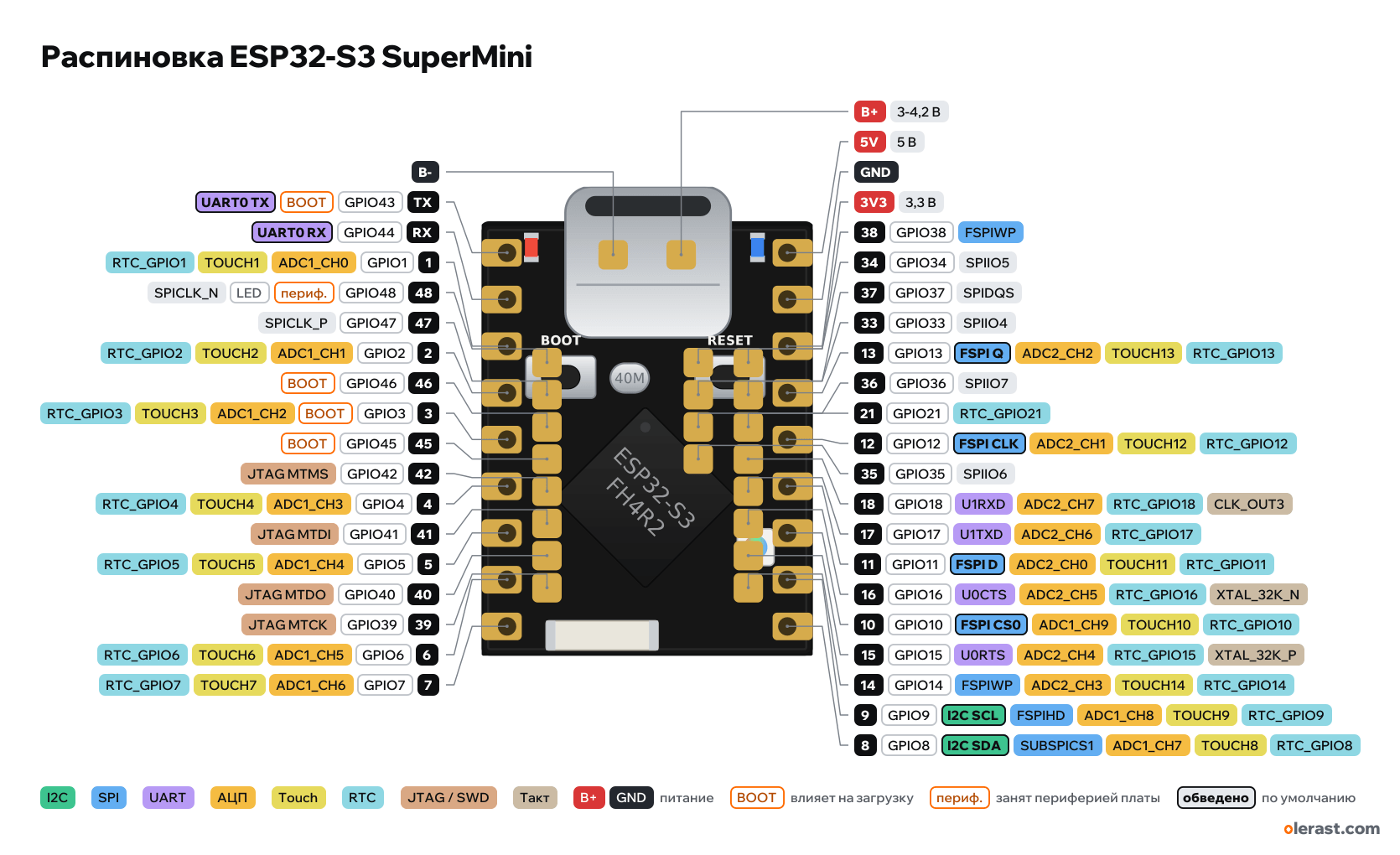
ESP32-S3 SuperMini pinout
ESP32-S3 SuperMini, ESP32-S3, 3.3 V logic, 18×23.5 mm, 40 pins
partly verified20.10.2026
- B-
- TXGPIO43BOOTUART0 TX
- RXGPIO44UART0 RX
- 1GPIO1ADC1_CH0TOUCH1RTC_GPIO1
- 48GPIO48periph.LEDSPICLK_N
- 47GPIO47SPICLK_P
- 2GPIO2ADC1_CH1TOUCH2RTC_GPIO2
- 46GPIO46BOOT
- 3GPIO3BOOTADC1_CH2TOUCH3RTC_GPIO3
- 45GPIO45BOOT
- 42GPIO42JTAG MTMS
- 4GPIO4ADC1_CH3TOUCH4RTC_GPIO4
- 41GPIO41JTAG MTDI
- 5GPIO5ADC1_CH4TOUCH5RTC_GPIO5
- 40GPIO40JTAG MTDO
- 39GPIO39JTAG MTCK
- 6GPIO6ADC1_CH5TOUCH6RTC_GPIO6
- 7GPIO7ADC1_CH6TOUCH7RTC_GPIO7
- B+3-4.2 V
- 5V5 V
- GND
- 3V33.3 V
- 38GPIO38FSPIWP
- 34GPIO34SPIIO5
- 37GPIO37SPIDQS
- 33GPIO33SPIIO4
- 13GPIO13FSPI QADC2_CH2TOUCH13RTC_GPIO13
- 36GPIO36SPIIO7
- 21GPIO21RTC_GPIO21
- 12GPIO12FSPI CLKADC2_CH1TOUCH12RTC_GPIO12
- 35GPIO35SPIIO6
- 18GPIO18U1RXDADC2_CH7RTC_GPIO18CLK_OUT3
- 17GPIO17U1TXDADC2_CH6RTC_GPIO17
- 11GPIO11FSPI DADC2_CH0TOUCH11RTC_GPIO11
- 16GPIO16U0CTSADC2_CH5RTC_GPIO16XTAL_32K_N
- 10GPIO10FSPI CS0ADC1_CH9TOUCH10RTC_GPIO10
- 15GPIO15U0RTSADC2_CH4RTC_GPIO15XTAL_32K_P
- 14GPIO14FSPIWPADC2_CH3TOUCH14RTC_GPIO14
- 9GPIO9I2C SCLFSPIHDADC1_CH8TOUCH9RTC_GPIO9
- 8GPIO8I2C SDASUBSPICS1ADC1_CH7TOUCH8RTC_GPIO8
Top view (chip side), USB-C at the top, ceramic antenna at the bottom.
CompareDownload PNG- Chip
- ESP32-S3
- Logic
- 3.3 V
- Power
- USB-C 4.75-5.25 V5V 4.75-5.25 V3V3 3-3.6 VLi-ion 3.7 V (B+ and B- pads on the bottom) 3.3-4.2 V
- Defaults in arduino-esp32 (ESP32S3 Dev Module)
- I2C: SDA 8, SCL 9SPI: MOSI 11, MISO 13, SCK 12, SS 10UART: TX 43, RX 44LED: 48
Which ESP32-S3 SuperMini pins are safe to use
Free to use
GPIO1, GPIO2, GPIO4-18, GPIO21, GPIO33-42, GPIO44, GPIO47
Use with care
- GPIO3, GPIO45, GPIO46: strapping: the level at power-up selects the boot mode.
- GPIO43: signal at boot.
- GPIO48: onboard peripherals are wired to them.
Important
- 3.3 V logic, don't put 5 V on the GPIO.
- USB-C goes straight to the chip (GPIO19/20), there is no USB-UART bridge. In Arduino enable "USB CDC On Boot". If the port does not appear, connect with BOOT held.
- GPIO0 is routed only to the BOOT button. GPIO19/20 are used by USB and not broken out.
- GPIO48 is used by the LEDs (RGB WS2812). In arduino-esp32 for "ESP32S3 Dev Module" RGB_BUILTIN = 48.
- Strapping: GPIO3 (side), GPIO45 and GPIO46 (bottom). Do not pull them to power or ground at power-up.
- ADC: ADC1 on GPIO1-10 (all on the side). ADC2 (GPIO11-20) may not work with Wi-Fi enabled.
- 2 MB PSRAM: in Arduino select "PSRAM: QSPI PSRAM". GPIO33-37 stay free then.
- 20 pads on the bottom for soldering wires, they do not fit a breadboard. The pad numbers are printed on the back. The drawing shows them through the board.
- The side pin labels are printed on the front between the holes. The drawing does not show them: the bottom pads would cover them.
- Rows 15.24 mm (0.6 inch) apart, 2.54 pitch: the board fits a breadboard.
- Small components are drawn approximately, from the seller photo.
- The 3.3 V regulator and charger IC types are not confirmed by any documents.
Revisions and clones
- Boards with a charger (Tenstar): B+ and B- pads on the bottom, the BOOST jumper raises the charge current from 100 to 300 mA (seller: only for batteries of 500 mAh or more), "BAT" LED. Other batches may have no charger or battery pads.
- The 18 side pins are the same in every description found. The bottom pads on boards without a charger are not checked.
- espboards.dev: on some boards the ceramic antenna is soldered rotated, so Wi-Fi is weaker (single source).
All pins
| Label | Number | Functions | Limits | Check |
|---|---|---|---|---|
| TX | GPIO43 | interruptPWM (LEDC)UART0 TX | not 5 V tolerantoutputs a signal at boot | not from manufacturerThere is no manufacturer document: several unnamed factories make this board. Order taken from the Tenstar Robot seller drawing and photos (parts of the description are copied from ESP32-C3) and from three independent KiCad footprints, which all agree. Coordinates ±0.2 mm.UART0 TX: bootloader log and Serial0. The USB port on the board is separate (USB Serial/JTAG). |
| RX | GPIO44 | interruptPWM (LEDC)UART0 RX | not 5 V tolerant | not from manufacturerThere is no manufacturer document: several unnamed factories make this board. Order taken from the Tenstar Robot seller drawing and photos (parts of the description are copied from ESP32-C3) and from three independent KiCad footprints, which all agree. Coordinates ±0.2 mm. |
| 1 | GPIO1 | interruptPWM (LEDC)ADC1_CH0TOUCH1RTC_GPIO1 | not 5 V tolerant | not from manufacturerThere is no manufacturer document: several unnamed factories make this board. Order taken from the Tenstar Robot seller drawing and photos (parts of the description are copied from ESP32-C3) and from three independent KiCad footprints, which all agree. Coordinates ±0.2 mm. |
| 2 | GPIO2 | interruptPWM (LEDC)ADC1_CH1TOUCH2RTC_GPIO2 | not 5 V tolerant | not from manufacturerThere is no manufacturer document: several unnamed factories make this board. Order taken from the Tenstar Robot seller drawing and photos (parts of the description are copied from ESP32-C3) and from three independent KiCad footprints, which all agree. Coordinates ±0.2 mm. |
| 3 | GPIO3 | interruptPWM (LEDC)ADC1_CH2TOUCH3RTC_GPIO3 | not 5 V tolerantaffects boot (strapping) | not from manufacturerThere is no manufacturer document: several unnamed factories make this board. Order taken from the Tenstar Robot seller drawing and photos (parts of the description are copied from ESP32-C3) and from three independent KiCad footprints, which all agree. Coordinates ±0.2 mm.Strapping: JTAG signal source selection. Floating by default, no effect unless the eFuse was changed. |
| 4 | GPIO4 | interruptPWM (LEDC)ADC1_CH3TOUCH4RTC_GPIO4 | not 5 V tolerant | not from manufacturerThere is no manufacturer document: several unnamed factories make this board. Order taken from the Tenstar Robot seller drawing and photos (parts of the description are copied from ESP32-C3) and from three independent KiCad footprints, which all agree. Coordinates ±0.2 mm. |
| 5 | GPIO5 | interruptPWM (LEDC)ADC1_CH4TOUCH5RTC_GPIO5 | not 5 V tolerant | not from manufacturerThere is no manufacturer document: several unnamed factories make this board. Order taken from the Tenstar Robot seller drawing and photos (parts of the description are copied from ESP32-C3) and from three independent KiCad footprints, which all agree. Coordinates ±0.2 mm. |
| 6 | GPIO6 | interruptPWM (LEDC)ADC1_CH5TOUCH6RTC_GPIO6 | not 5 V tolerant | not from manufacturerThere is no manufacturer document: several unnamed factories make this board. Order taken from the Tenstar Robot seller drawing and photos (parts of the description are copied from ESP32-C3) and from three independent KiCad footprints, which all agree. Coordinates ±0.2 mm. |
| 7 | GPIO7 | interruptPWM (LEDC)ADC1_CH6TOUCH7RTC_GPIO7 | not 5 V tolerant | not from manufacturerThere is no manufacturer document: several unnamed factories make this board. Order taken from the Tenstar Robot seller drawing and photos (parts of the description are copied from ESP32-C3) and from three independent KiCad footprints, which all agree. Coordinates ±0.2 mm. |
| 5V | 5 V | power inputpower output | not from manufacturerThere is no manufacturer document: several unnamed factories make this board. Order taken from the Tenstar Robot seller drawing and photos (parts of the description are copied from ESP32-C3) and from three independent KiCad footprints, which all agree. Coordinates ±0.2 mm.USB-C VBUS: an output of 5 V when powered from USB, otherwise a 5 V input. | |
| GND | Ground | not from manufacturerThere is no manufacturer document: several unnamed factories make this board. Order taken from the Tenstar Robot seller drawing and photos (parts of the description are copied from ESP32-C3) and from three independent KiCad footprints, which all agree. Coordinates ±0.2 mm. | ||
| 3V3 | 3.3 V | power inputpower output | not from manufacturerThere is no manufacturer document: several unnamed factories make this board. Order taken from the Tenstar Robot seller drawing and photos (parts of the description are copied from ESP32-C3) and from three independent KiCad footprints, which all agree. Coordinates ±0.2 mm.3.3 V regulator output or 3.3 V input. | |
| 13 | GPIO13 | interruptPWM (LEDC)ADC2_CH2TOUCH13RTC_GPIO13FSPI Q (MISO) | not 5 V tolerantADC2 doesn't work with Wi-Fi on | not from manufacturerThere is no manufacturer document: several unnamed factories make this board. Order taken from the Tenstar Robot seller drawing and photos (parts of the description are copied from ESP32-C3) and from three independent KiCad footprints, which all agree. Coordinates ±0.2 mm.ADC2: with Wi-Fi on, reading may not work (arbitration with Wi-Fi). Use GPIO1–10 for ADC. |
| 12 | GPIO12 | interruptPWM (LEDC)ADC2_CH1TOUCH12RTC_GPIO12FSPI CLK (SCK) | not 5 V tolerantADC2 doesn't work with Wi-Fi on | not from manufacturerThere is no manufacturer document: several unnamed factories make this board. Order taken from the Tenstar Robot seller drawing and photos (parts of the description are copied from ESP32-C3) and from three independent KiCad footprints, which all agree. Coordinates ±0.2 mm.ADC2: with Wi-Fi on, reading may not work (arbitration with Wi-Fi). Use GPIO1–10 for ADC. |
| 11 | GPIO11 | interruptPWM (LEDC)ADC2_CH0TOUCH11RTC_GPIO11FSPI D (MOSI) | not 5 V tolerantADC2 doesn't work with Wi-Fi on | not from manufacturerThere is no manufacturer document: several unnamed factories make this board. Order taken from the Tenstar Robot seller drawing and photos (parts of the description are copied from ESP32-C3) and from three independent KiCad footprints, which all agree. Coordinates ±0.2 mm.ADC2: with Wi-Fi on, reading may not work (arbitration with Wi-Fi). Use GPIO1–10 for ADC. |
| 10 | GPIO10 | interruptPWM (LEDC)ADC1_CH9TOUCH10RTC_GPIO10FSPI CS0 (SS) | not 5 V tolerant | not from manufacturerThere is no manufacturer document: several unnamed factories make this board. Order taken from the Tenstar Robot seller drawing and photos (parts of the description are copied from ESP32-C3) and from three independent KiCad footprints, which all agree. Coordinates ±0.2 mm. |
| 9 | GPIO9 | interruptPWM (LEDC)ADC1_CH8TOUCH9RTC_GPIO9I2C SCLFSPIHD | not 5 V tolerant | not from manufacturerThere is no manufacturer document: several unnamed factories make this board. Order taken from the Tenstar Robot seller drawing and photos (parts of the description are copied from ESP32-C3) and from three independent KiCad footprints, which all agree. Coordinates ±0.2 mm. |
| 8 | GPIO8 | interruptPWM (LEDC)ADC1_CH7TOUCH8RTC_GPIO8I2C SDASUBSPICS1 | not 5 V tolerant | not from manufacturerThere is no manufacturer document: several unnamed factories make this board. Order taken from the Tenstar Robot seller drawing and photos (parts of the description are copied from ESP32-C3) and from three independent KiCad footprints, which all agree. Coordinates ±0.2 mm. |
| 48 | GPIO48 | interruptPWM (LEDC)SPICLK_N | not 5 V tolerantonboard LEDused by onboard peripherals (camera, card, display) | not from manufacturerThere is no manufacturer document: several unnamed factories make this board. Order taken from the Tenstar Robot seller drawing and photos (parts of the description are copied from ESP32-C3) and from three independent KiCad footprints, which all agree. Coordinates ±0.2 mm. Pads on the bottom: numbers from the Tenstar drawing, coordinates from two footprints (they differ by up to 0.1 mm). Whether every batch has the pads is not checked.Used by the board LEDs: the WS2812 RGB LED (data) and, on some boards, a single-color LED next to the "48" label. |
| 47 | GPIO47 | interruptPWM (LEDC)SPICLK_P | not 5 V tolerant | not from manufacturerThere is no manufacturer document: several unnamed factories make this board. Order taken from the Tenstar Robot seller drawing and photos (parts of the description are copied from ESP32-C3) and from three independent KiCad footprints, which all agree. Coordinates ±0.2 mm. Pads on the bottom: numbers from the Tenstar drawing, coordinates from two footprints (they differ by up to 0.1 mm). Whether every batch has the pads is not checked. |
| 46 | GPIO46 | interruptPWM (LEDC) | not 5 V tolerantaffects boot (strapping) | not from manufacturerThere is no manufacturer document: several unnamed factories make this board. Order taken from the Tenstar Robot seller drawing and photos (parts of the description are copied from ESP32-C3) and from three independent KiCad footprints, which all agree. Coordinates ±0.2 mm. Pads on the bottom: numbers from the Tenstar drawing, coordinates from two footprints (they differ by up to 0.1 mm). Whether every batch has the pads is not checked.Strapping: together with GPIO0 selects the boot mode. Internal pull-down, must be low when booting over UART. |
| 45 | GPIO45 | interruptPWM (LEDC) | not 5 V tolerantaffects boot (strapping) | not from manufacturerThere is no manufacturer document: several unnamed factories make this board. Order taken from the Tenstar Robot seller drawing and photos (parts of the description are copied from ESP32-C3) and from three independent KiCad footprints, which all agree. Coordinates ±0.2 mm. Pads on the bottom: numbers from the Tenstar drawing, coordinates from two footprints (they differ by up to 0.1 mm). Whether every batch has the pads is not checked.Strapping: VDD_SPI voltage. Internal pull-down, do not pull high at reset. |
| 42 | GPIO42 | interruptPWM (LEDC)JTAG MTMS | not 5 V tolerant | not from manufacturerThere is no manufacturer document: several unnamed factories make this board. Order taken from the Tenstar Robot seller drawing and photos (parts of the description are copied from ESP32-C3) and from three independent KiCad footprints, which all agree. Coordinates ±0.2 mm. Pads on the bottom: numbers from the Tenstar drawing, coordinates from two footprints (they differ by up to 0.1 mm). Whether every batch has the pads is not checked. |
| 41 | GPIO41 | interruptPWM (LEDC)JTAG MTDI | not 5 V tolerant | not from manufacturerThere is no manufacturer document: several unnamed factories make this board. Order taken from the Tenstar Robot seller drawing and photos (parts of the description are copied from ESP32-C3) and from three independent KiCad footprints, which all agree. Coordinates ±0.2 mm. Pads on the bottom: numbers from the Tenstar drawing, coordinates from two footprints (they differ by up to 0.1 mm). Whether every batch has the pads is not checked. |
| 40 | GPIO40 | interruptPWM (LEDC)JTAG MTDO | not 5 V tolerant | not from manufacturerThere is no manufacturer document: several unnamed factories make this board. Order taken from the Tenstar Robot seller drawing and photos (parts of the description are copied from ESP32-C3) and from three independent KiCad footprints, which all agree. Coordinates ±0.2 mm. Pads on the bottom: numbers from the Tenstar drawing, coordinates from two footprints (they differ by up to 0.1 mm). Whether every batch has the pads is not checked. |
| 39 | GPIO39 | interruptPWM (LEDC)JTAG MTCK | not 5 V tolerant | not from manufacturerThere is no manufacturer document: several unnamed factories make this board. Order taken from the Tenstar Robot seller drawing and photos (parts of the description are copied from ESP32-C3) and from three independent KiCad footprints, which all agree. Coordinates ±0.2 mm. Pads on the bottom: numbers from the Tenstar drawing, coordinates from two footprints (they differ by up to 0.1 mm). Whether every batch has the pads is not checked. |
| 38 | GPIO38 | interruptPWM (LEDC)FSPIWP | not 5 V tolerant | not from manufacturerThere is no manufacturer document: several unnamed factories make this board. Order taken from the Tenstar Robot seller drawing and photos (parts of the description are copied from ESP32-C3) and from three independent KiCad footprints, which all agree. Coordinates ±0.2 mm. Pads on the bottom: numbers from the Tenstar drawing, coordinates from two footprints (they differ by up to 0.1 mm). Whether every batch has the pads is not checked. |
| 37 | GPIO37 | interruptPWM (LEDC)SPIDQS (Octal) | not 5 V tolerant | not from manufacturerThere is no manufacturer document: several unnamed factories make this board. Order taken from the Tenstar Robot seller drawing and photos (parts of the description are copied from ESP32-C3) and from three independent KiCad footprints, which all agree. Coordinates ±0.2 mm. Pads on the bottom: numbers from the Tenstar drawing, coordinates from two footprints (they differ by up to 0.1 mm). Whether every batch has the pads is not checked.Used on modules with octal PSRAM or flash (N8R8, N16R8, N32R8). Do not use on such modules.On the ESP32-S3FH4R2 the PSRAM is quad (Quad) inside the package, the pin is free. |
| 36 | GPIO36 | interruptPWM (LEDC)SPIIO7 (Octal) | not 5 V tolerant | not from manufacturerThere is no manufacturer document: several unnamed factories make this board. Order taken from the Tenstar Robot seller drawing and photos (parts of the description are copied from ESP32-C3) and from three independent KiCad footprints, which all agree. Coordinates ±0.2 mm. Pads on the bottom: numbers from the Tenstar drawing, coordinates from two footprints (they differ by up to 0.1 mm). Whether every batch has the pads is not checked.Used on modules with octal PSRAM or flash (N8R8, N16R8, N32R8). Do not use on such modules.On the ESP32-S3FH4R2 the PSRAM is quad (Quad) inside the package, the pin is free. |
| 35 | GPIO35 | interruptPWM (LEDC)SPIIO6 (Octal) | not 5 V tolerant | not from manufacturerThere is no manufacturer document: several unnamed factories make this board. Order taken from the Tenstar Robot seller drawing and photos (parts of the description are copied from ESP32-C3) and from three independent KiCad footprints, which all agree. Coordinates ±0.2 mm. Pads on the bottom: numbers from the Tenstar drawing, coordinates from two footprints (they differ by up to 0.1 mm). Whether every batch has the pads is not checked.Used on modules with octal PSRAM or flash (N8R8, N16R8, N32R8). Do not use on such modules.On the ESP32-S3FH4R2 the PSRAM is quad (Quad) inside the package, the pin is free. |
| 34 | GPIO34 | interruptPWM (LEDC)SPIIO5 (Octal) | not 5 V tolerant | not from manufacturerThere is no manufacturer document: several unnamed factories make this board. Order taken from the Tenstar Robot seller drawing and photos (parts of the description are copied from ESP32-C3) and from three independent KiCad footprints, which all agree. Coordinates ±0.2 mm. Pads on the bottom: numbers from the Tenstar drawing, coordinates from two footprints (they differ by up to 0.1 mm). Whether every batch has the pads is not checked.Used on modules and chips with Octal PSRAM or flash (N8R8, N16R8). Free on the ESP32-S3FH4R2. |
| 33 | GPIO33 | interruptPWM (LEDC)SPIIO4 (Octal) | not 5 V tolerant | not from manufacturerThere is no manufacturer document: several unnamed factories make this board. Order taken from the Tenstar Robot seller drawing and photos (parts of the description are copied from ESP32-C3) and from three independent KiCad footprints, which all agree. Coordinates ±0.2 mm. Pads on the bottom: numbers from the Tenstar drawing, coordinates from two footprints (they differ by up to 0.1 mm). Whether every batch has the pads is not checked.Used on modules and chips with Octal PSRAM or flash (N8R8, N16R8). Free on the ESP32-S3FH4R2. |
| 21 | GPIO21 | interruptPWM (LEDC)RTC_GPIO21 | not 5 V tolerant | not from manufacturerThere is no manufacturer document: several unnamed factories make this board. Order taken from the Tenstar Robot seller drawing and photos (parts of the description are copied from ESP32-C3) and from three independent KiCad footprints, which all agree. Coordinates ±0.2 mm. Pads on the bottom: numbers from the Tenstar drawing, coordinates from two footprints (they differ by up to 0.1 mm). Whether every batch has the pads is not checked. |
| 18 | GPIO18 | interruptPWM (LEDC)ADC2_CH7RTC_GPIO18U1RXDCLK_OUT3 | not 5 V tolerantADC2 doesn't work with Wi-Fi on | not from manufacturerThere is no manufacturer document: several unnamed factories make this board. Order taken from the Tenstar Robot seller drawing and photos (parts of the description are copied from ESP32-C3) and from three independent KiCad footprints, which all agree. Coordinates ±0.2 mm. Pads on the bottom: numbers from the Tenstar drawing, coordinates from two footprints (they differ by up to 0.1 mm). Whether every batch has the pads is not checked.ADC2: with Wi-Fi on, reading may not work (arbitration with Wi-Fi). Use GPIO1–10 for ADC. |
| 17 | GPIO17 | interruptPWM (LEDC)ADC2_CH6RTC_GPIO17U1TXD | not 5 V tolerantADC2 doesn't work with Wi-Fi on | not from manufacturerThere is no manufacturer document: several unnamed factories make this board. Order taken from the Tenstar Robot seller drawing and photos (parts of the description are copied from ESP32-C3) and from three independent KiCad footprints, which all agree. Coordinates ±0.2 mm. Pads on the bottom: numbers from the Tenstar drawing, coordinates from two footprints (they differ by up to 0.1 mm). Whether every batch has the pads is not checked.ADC2: with Wi-Fi on, reading may not work (arbitration with Wi-Fi). Use GPIO1–10 for ADC. |
| 16 | GPIO16 | interruptPWM (LEDC)ADC2_CH5RTC_GPIO16XTAL_32K_NU0CTS | not 5 V tolerantADC2 doesn't work with Wi-Fi on | not from manufacturerThere is no manufacturer document: several unnamed factories make this board. Order taken from the Tenstar Robot seller drawing and photos (parts of the description are copied from ESP32-C3) and from three independent KiCad footprints, which all agree. Coordinates ±0.2 mm. Pads on the bottom: numbers from the Tenstar drawing, coordinates from two footprints (they differ by up to 0.1 mm). Whether every batch has the pads is not checked.ADC2: with Wi-Fi on, reading may not work (arbitration with Wi-Fi). Use GPIO1–10 for ADC. |
| 15 | GPIO15 | interruptPWM (LEDC)ADC2_CH4RTC_GPIO15XTAL_32K_PU0RTS | not 5 V tolerantADC2 doesn't work with Wi-Fi on | not from manufacturerThere is no manufacturer document: several unnamed factories make this board. Order taken from the Tenstar Robot seller drawing and photos (parts of the description are copied from ESP32-C3) and from three independent KiCad footprints, which all agree. Coordinates ±0.2 mm. Pads on the bottom: numbers from the Tenstar drawing, coordinates from two footprints (they differ by up to 0.1 mm). Whether every batch has the pads is not checked.ADC2: with Wi-Fi on, reading may not work (arbitration with Wi-Fi). Use GPIO1–10 for ADC. |
| 14 | GPIO14 | interruptPWM (LEDC)ADC2_CH3TOUCH14RTC_GPIO14FSPIWP | not 5 V tolerantADC2 doesn't work with Wi-Fi on | not from manufacturerThere is no manufacturer document: several unnamed factories make this board. Order taken from the Tenstar Robot seller drawing and photos (parts of the description are copied from ESP32-C3) and from three independent KiCad footprints, which all agree. Coordinates ±0.2 mm. Pads on the bottom: numbers from the Tenstar drawing, coordinates from two footprints (they differ by up to 0.1 mm). Whether every batch has the pads is not checked.ADC2: with Wi-Fi on, reading may not work (arbitration with Wi-Fi). Use GPIO1–10 for ADC. |
| B+ | 3.7 V | power input | not from manufacturerThere is no manufacturer document: several unnamed factories make this board. Order taken from the Tenstar Robot seller drawing and photos (parts of the description are copied from ESP32-C3) and from three independent KiCad footprints, which all agree. Coordinates ±0.2 mm. Pads on the bottom: numbers from the Tenstar drawing, coordinates from two footprints (they differ by up to 0.1 mm). Whether every batch has the pads is not checked. The battery pads exist only on boards with a charger.Li-ion battery positive, 3.7 V: charged from USB at 100 mA, 300 mA with the BOOST jumper (per the seller description). | |
| B- | Ground | not from manufacturerThere is no manufacturer document: several unnamed factories make this board. Order taken from the Tenstar Robot seller drawing and photos (parts of the description are copied from ESP32-C3) and from three independent KiCad footprints, which all agree. Coordinates ±0.2 mm. Pads on the bottom: numbers from the Tenstar drawing, coordinates from two footprints (they differ by up to 0.1 mm). Whether every batch has the pads is not checked. The battery pads exist only on boards with a charger.Battery negative. |
Sources
Not verified against the manufacturer: 40 of 40 pins. The pin card says what confirms each one and where sources disagree.
- Tenstar Robot: ESP32-S3 SuperMini, product description with pinout and photo (AliExpress)third-party source, checked 20.10.2026photo labels: left TX, RX, 1-7, right 5V, GND, 3V3, 13-8; 20 pads on the bottom with GPIO numbers, B+ and B-, BOOST jumper (100/300 mA); LEDs on GPIO48, BOOT and RESET buttons, size 18×23.5 mm, chip ESP32-S3FH4R2
- willbearfruits/samplooler: KiCad footprint ESP32-S3_SuperMinithird-party source, checked 20.10.202618-pin order as on Tenstar, rows 15.24-15.45 mm apart, outermost pin 1.59 mm from the end, coordinates of the 20 bottom pads (1.753 pitch) and their GPIOs
- TanmayChhatbar/esp32-can_datalogger: KiCad footprint ESP32-S3 Superminithird-party source, checked 20.10.202618×23.5 mm outline, 9 pins per side at 2.54 pitch, bottom pads in three columns at 1.75 pitch (x 3.5, 11.75, 14.5), two battery pads next to USB
- mhellar/speakhard: KiCad footprint ESP32-S3_SuperMini_CNCthird-party source, checked 20.10.2026rows 15.24 mm apart; left from top to bottom TX, RX, 1-7, right 5V, GND, 3V3, 13-8
- espboards.dev: ESP32-S3 Super Minithird-party source, checked 20.10.2026ESP32-S3FH4R2, WS2812 on GPIO48, bottom pads, B+ and B-, BOOST, on some boards the antenna is mounted rotated
- ESPHome devices: Tenstar Robot ESP32-S3 SuperMinithird-party source, checked 20.10.2026WS2812B on GPIO48, 2 MB Quad PSRAM, battery charging
- ESP32-S3 Series Datasheet (Espressif)datasheet, checked 15.10.2026pin functions: ADC1_CH0–9 on GPIO1–10, ADC2_CH0–9 on GPIO11–20, TOUCH1–14, RTC GPIO0–21, USB GPIO19/20, JTAG GPIO39–42, UART0 GPIO43/44, strapping GPIO0/3/45/46
- ESP-IDF: GPIO (ESP32-S3)user guide, checked 15.10.2026GPIO26–32 are used by SPI flash/PSRAM, GPIO33–37 are used on modules with Octal flash/PSRAM, strapping pins, USB
- arduino-esp32: variants/esp32s3/pins_arduino.hArduino core, checked 15.10.2026defaults: TX 43, RX 44, SDA 8, SCL 9, SS 10, MOSI 11, MISO 13, SCK 12
Size: 18×23.5 mm per the seller description and KiCad footprints (18.09×23.5); no drawing (approximate).
FAQ
- Which ESP32-S3 SuperMini pins are I2C, SPI and UART?
- By default in arduino-esp32 (ESP32S3 Dev Module): I2C: SDA GPIO8, SCL GPIO9; SPI: MOSI GPIO11, MISO GPIO13, SCK GPIO12, SS GPIO10; UART: TX GPIO43, RX GPIO44.
- Which pin is the ESP32-S3 SuperMini LED on?
- LED next to the "48" label on GPIO48 (not on all boards, the color differs between batches).
- Are the ESP32-S3 SuperMini pins 5 V tolerant?
- No. The logic is 3.3 V and the pins are not 5 V tolerant: use a divider or a level shifter for 5 V signals.
- Does ADC2 on the ESP32-S3 SuperMini work with Wi-Fi on?
- No. ADC2 pins (GPIO11-18) can't read analog while Wi-Fi is on. With Wi-Fi, use GPIO1-10 for the ADC.
You might also need
Schematic with this board
schematic builder with the board already placed
Flash this board
upload a sketch or .bin to this board from the browser
Power budget
will the regulator cope and how long the battery lasts
Calculators
LED resistor, voltage divider, battery runtime, 3D print cost, LED strip power supply and pF, nF, µF conversion
Similar boards

Next
- Emotion keychainmy ESP32-S3 project, prototype
- Troll Botmy ESP32-S3 project, prototype
- olerast PULSEmy ESP32-S3 project, in development
Need firmware or a device built on ESP32? I'll build it to order